TABLA
PERIODICA
Al principio se pensaba
que los elementos de toda materia se resumían al agua, tierra, fuego y aire.
Sin embargo al cabo del tiempo y gracias a la mejora de las técnicas de
experimentación física y química, nos dimos cuenta de que la materia es en
realidad más compleja de lo que parece. Los químicos del siglo XIX encontraron
entonces la necesidad de ordenar los nuevos elementos descubiertos. La primera
manera, la más natural, fue la de clasificarlos por masas atómicas, pero esta
clasificación no reflejaba las diferencias y similitudes entre los elementos.
Muchas más clasificaciones fueron adoptadas antes de llegar a la tabla
periódica que es utilizada en nuestros días.
En San
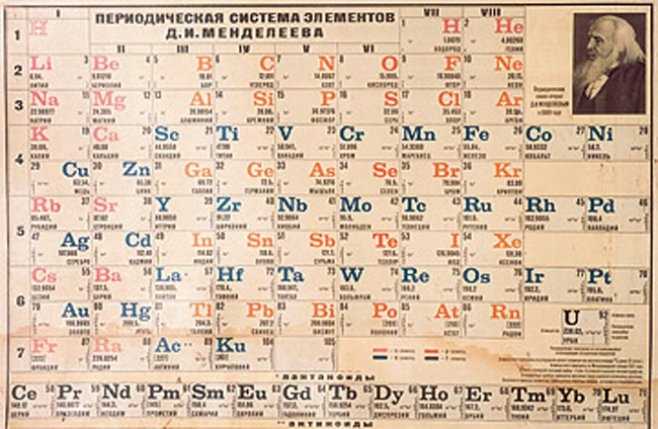
Petersburgo (Rusia), el químico Dmitri Mendeléyev, presenta una primera versión de su tabla periódica de elementos
ante la Sociedad Química de Rusia. Es la primera tabla coherente de las
semejanzas de los elementos químicos, según sus masas atómicas. En ella
aparecen los 63 elementos conocidos en esa época en orden creciente de peso
atómico.
CARACTERISTICAS

Los
renglones de la tabla periódica se llaman períodos, pues de su longitud depende
la periodicidad con que se repiten las propiedades similares según la ley
periódica. Debe notarse que los períodos tienen diferente longitud, así el
primer período sólo contiene dos elementos (Hidrógeno y Helio), en tanto que el
segundo período contiene 8 elementos y el cuarto 18.
Los
períodos sexto y séptimo están "recortados" y los elementos cortados
de ahí aparecen separados de la tabla en la parte inferior; esto se hace para
no tener una tabla demasiado larga, aunque recientemente es común ver tablas
que reincorporan a su período a estos elementos, algunos denominan a este tipo
de tablas extra largas.
Las
columnas de la tabla se conocen como grupos o familias y contienen como ya lo
hemos dicho, a los elementos que tienen propiedades similares y, desde el punto
de vista de la teoría, configuraciones electrónicas externas iguales.
Los
elementos de la tabla periódica se pueden dividir en tres grandes conjuntos, a
saber: elementos representativos que conforman las primeras dos columnas y las
últimas seis de la tabla; metales de transición que constituyen diez columnas
al centro de la tabla y metales de transición interna que comprenden las
catorce columnas de la parte inferior de la tabla.
Los
ocho grupos de elementos representativos tradicionalmente se han numerado con
números romanos del I al VIII y con el subíndice a, la razón de esto es
histórica, pues en la tabla corta los elementos representativos se mezclaban
con los de transición, a los que se les asignaba el subíndice b.
Los
dos primeros grupos de elementos representativos se conocen como bloque s (Figura
12), debido a que su configuración electrónica del estado fundamental termina
en un orbital s. El primer grupo está conformado por una serie de elementos
metálicos (a excepción del Hidrógeno) y se denomina grupo de los metales
alcalinos.
Elementos de transición
Los átomos de los elementos
siempre tienden a ser estables energéticamente, por lo cual ceden, comparten o
pierden electrones. Esta estructura estable coincide cuando en su último nivel
hay ocho electrones, pero en el caso de este grupo particular de elementos, se
suspende el llenado del último nivel para completar primero el penúltimo nivel.
Por esta razón aunque los demás elementos de la tabla periódica tiendan a
realizar sus enlaces utilizando los electrones del último nivel de energía,
éstos lo hacen tanto con los electrones del último nivel, como con los del
penúltimo. Se caracterizan además, por poseer gran cantidad de estados de
oxidación, es decir, que involucran diferentes cantidades de electrones para
intervenir en un enlace, lo que hace que formen varios compuestos.
Electronegatividad
Si se
analizan las propiedades de los elementos químicos, también se puede establecer
que hay periodicidad teniendo en cuenta la electronegatividad de los elementos
químicos, que básicamente es la tendencia que tienen los átomos de atraer o
captar electrones; son ejemplo de ello el oxígeno y el cloro, ya que la
electronegatividad aumenta en un periodo de izquierda a derecha y en un grupo
de abajo hacia arriba. Y si localizas estos dos elementos se ubican en los lugares
más electronegativos de la tabla periódica. Este concepto fue establecido por
L. Pauling, quien determinó valores de electronegatividad para cada uno de los
elementos; algunos ejemplos se muestran en la tabla que sigue:
Na Mg Al P Cl F Br I At Fr
0.9 1.2 1.5 2.1 3.0 4.0 2.8 2.5 2.2 0.7
Valencia
Para establecer de qué manera
los átomos se relacionan, es necesario saber la cantidad de electrones que un
átomo puede atraer (ganar), ceder (perder) o compartir con otro átomo, concepto
que se conoce con el nombre de valencia. La ilustración 3.16, muestra la forma
como se relacionan dos átomos de dos elementos, para formar un compuesto: el
átomo de sodio pierde un electrón, es decir su valencia es 1 y el átomo de
cloro gana 1 electrón, entonces su valencia también es 1. En síntesis, la
valencia es el poder de combinación de un elemento con otro, dado por los
electrones del último nivel.
Enlace
la union entre los átomos se denomina enlace, que es una fuerza de atracción lo
suficientemente intensa como para permitir que los átomos involucrados
funcionen como una unidad. Se realiza básicamente entre los electrones del
ultimo nivel de energía y se produce cuando .las fuerzas de atracción superan
las de repulsión, clasificándose, según la manera de establecer la unión. Así
pues:
Enlace
iónico: se origina cuando un átomo cede y otro captura los electrones.
Enlace
covalente: se origina cuando los átomos involucrados comparten sus electrones,
dado que tienen la misma fuerza de atracción.
Ejemplo:
Para más información haga click aquí https://youtu.be/h8N0hiPryFs
PERIODIC TABLE
At first it was thought that the
elements of all matter were summarized to water, earth, fire and air. However,
over time and thanks to the improvement of physical and chemical
experimentation techniques, we realized that matter is actually more complex
than it seems. The chemists of the 19th century then found the need to order
the new elements discovered. The first way, the most natural, was to classify
them by atomic masses, but this classification did not reflect the differences
and similarities between the elements. Many more classifications were adopted
before arriving at the periodic table that is used in our days.
In St. Petersburg (Russia), the
chemist Dmitri Mendeleev presents a first version of his periodic table of
elements before the Chemical Society of Russia. It is the first coherent table
of the similarities of the chemical elements, according to their atomic masses.
In it appear the 63 elements known at that time in increasing order of atomic
weight.

CHARACTERISTICS
The lines of the periodic table are
called periods, since their length depends on the periodicity with which
similar properties are repeated according to the periodic law. It should be
noted that the periods have different length, so the first period contains only
two elements (Hydrogen and Helium), while the second period contains 8 elements
and the fourth 18.
The sixth and seventh periods are
"cut out" and the cut elements there are separated from the table at
the bottom; this is done so as not to have a table that is too long, although
recently it is common to see tables that reincorporate these elements to their
period, some of them call this type of extra long tables.
The columns of the table are known as
groups or families and contain, as we have said, the elements that have similar
properties and, from the point of view of the theory, equal external electronic
configurations.
The elements of the periodic table
can be divided into three large groups, namely: representative elements that
make up the first two columns and the last six of the table; transition metals
that constitute ten columns at the center of the table and internal transition
metals that comprise the fourteen columns at the bottom of the table.
The eight groups of representative
elements have traditionally been numbered with Roman numerals from I to VIII
and with the subscript a, the reason for this is historical, since in the short
table the representative elements were mixed with the transitional ones, which
were assigned the subscript b.
The first two groups of
representative elements are known as blocks s (Figure 12), because their
electronic configuration of the ground state ends in an orbital s. The first
group is made up of a series of metallic elements (with the exception of
hydrogen) and is called the alkali metal group.
Elements of transition
The atoms of the elements always tend
to be energetically stable, which is why they give up, share or lose electrons.
This stable structure coincides when there are eight electrons in its last level,
but in the case of this particular group of elements, the filling of the last
level is suspended to complete the penultimate level first. For this reason
although the other elements of the periodic table tend to make their links
using the electrons of the last energy level, they do so with the electrons of
the last level, as with those of the penultimate. They are also characterized
by having a large number of oxidation states, that is, involving different
amounts of electrons to intervene in a bond, which causes them to form several
compounds.
Electronegativity
If the properties of the chemical
elements are analyzed, it can also be established that there is periodicity
taking into account the electronegativity of the chemical elements, which
basically is the tendency of atoms to attract or capture electrons; oxygen and
chlorine are examples of this, since electronegativity increases in a period
from left to right and in a group from bottom to top. And if you locate these
two elements they are located in the most electronegative places of the
periodic table. This concept was established by L. Pauling, who determined
electronegativity values for each of the elements; Some
examples are shown in the table below:
Na Mg Al P Cl F Br I At Fr
0.9 1.2 1.5 2.1 3.0 4.0 2.8 2.5 2.2 0.7
Valencia
To establish how atoms are related,
it is necessary to know the amount of electrons that an atom can attract
(gain), yield (lose) or share with another atom, a concept known as valence.
Illustration 3.16 shows how two atoms of two elements are related to form a
compound: the sodium atom loses an electron, that is, its valence is 1 and the
chlorine atom gains 1 electron, then its valence is also 1 In short, valence is
the power of combination of one element with another, given by the electrons of
the last level.
Link
the union between the atoms is called
a bond, which is a force of attraction intense enough to allow the atoms
involved to function as a unit. It is carried out basically between the
electrons of the last energy level and it is produced when the forces of
attraction overcome those of repulsion, classifying themselves, according to
the way of establishing the union. So that:
Ionic bond: it originates when one
atom yields and another captures the electrons.
Covalent bond: originates when the
atoms involved share their electrons, since they have the same attractive
force.
Example:
For more information click here
Example:
For more information click here
